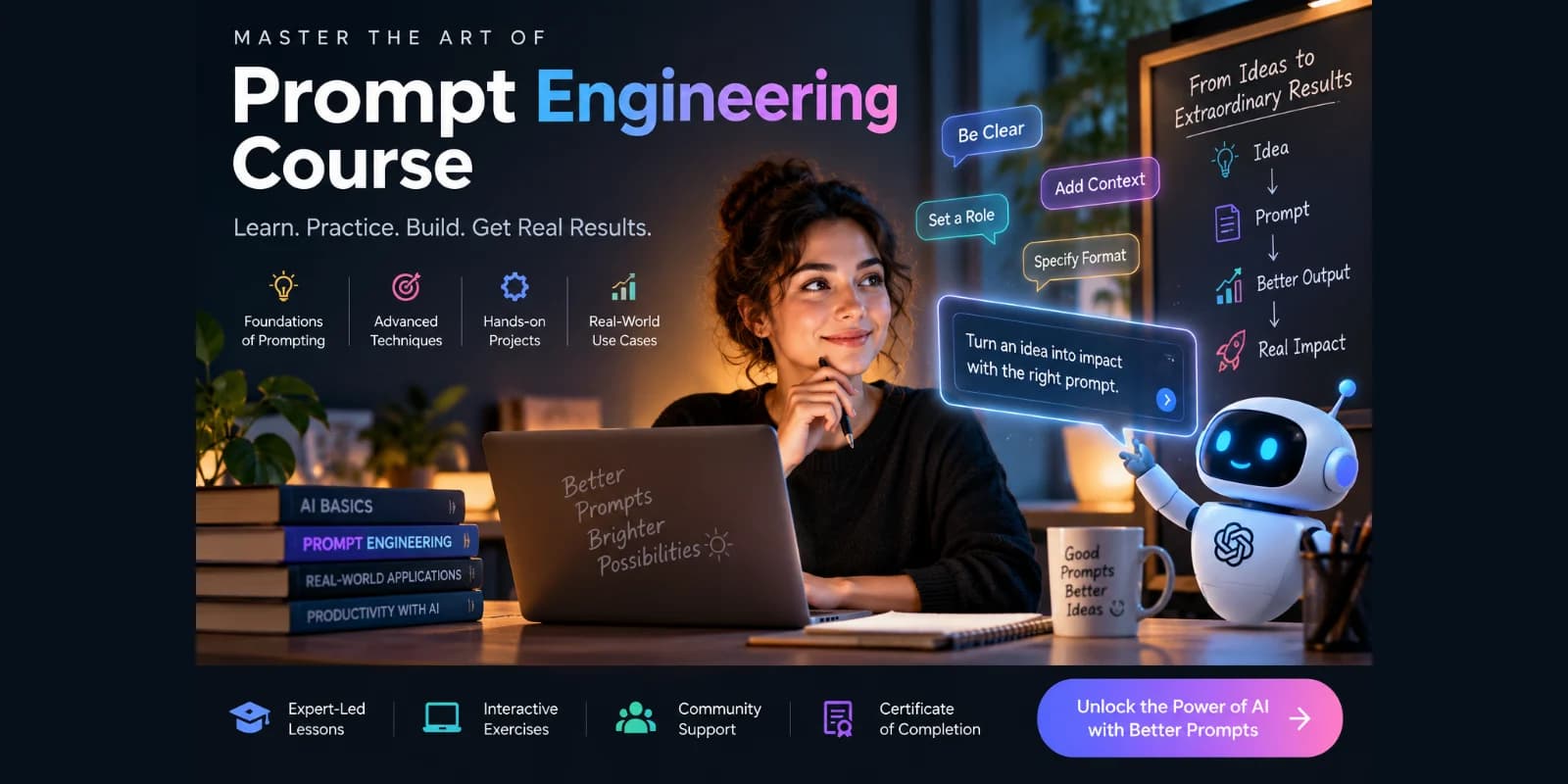
A prompt engineer course does not teach you to write clever ChatGPT questions, it teaches structured frameworks for extracting consistent, measurable business value from large language models at scale. Most UAE businesses approach prompt engineering training with outdated assumptions borrowed from early 2023, when the field barely existed and everyone was experimenting. Two years later, the commercial reality has shifted: enterprises need repeatable workflows, not viral Twitter prompts, and the ROI comes from systematizing AI interactions across teams, not from individual power users.
If you are evaluating a digital marketing course in Dubai or AI training for your team, understanding what prompt engineering actually requires will save you from enrolling in the wrong program or setting the wrong expectations. Here are the biggest myths UAE businesses hold about prompt engineer courses, and what you should know instead.
Myth: Prompt Engineering Is Just Learning the Right Keywords
Many businesses believe a prompt engineer course will hand them a list of magic words like "act as an expert" or "think step by step" that unlock better AI outputs. The truth is that keyword tricks stop working the moment your use case becomes complex or your context changes. Professional prompt engineering is a design discipline: you learn to structure instructions, manage context windows, chain reasoning steps, handle edge cases, and version-control prompts like code. A serious course teaches you schema design, output validation, error handling, and iteration loops, not a cheat sheet of phrases. If a program promises "500 ready-made prompts," it is training you to copy-paste, not to engineer.
The commercial implication matters. A marketing manager who memorizes prompts will hit a wall the first time the AI hallucinates a fact or drifts off-topic in a long conversation. A trained prompt engineer diagnoses why the model failed, rewrites the instruction set, tests it across scenarios, and documents the solution for the next team member. That is the skill UAE businesses actually need as they move from experiments to production AI workflows.

Myth: You Need a Technical or Coding Background
Another common belief is that prompt engineering courses are only for developers or data scientists. In reality, the best prompt engineers often come from non-technical backgrounds like content writing, customer service, legal research, or marketing, because they understand language nuance, audience intent, and domain context. Modern LLMs respond to natural language instructions, so the skill is closer to technical writing than to Python scripting. A good course will teach you how to think in systems and logic without requiring you to write a single line of code.
That said, understanding basic concepts like JSON formatting, API call structure, and token limits does help when you want to integrate prompts into automated workflows or build AI agents. A robust AI course in Dubai will introduce these concepts accessibly, giving non-technical participants enough grounding to collaborate with developers without drowning them in syntax. The point is to make you dangerous enough to design the prompt logic while engineers handle the plumbing.
Myth: One Course Covers All AI Tools Equally
Many buyers assume a prompt engineer course will teach them ChatGPT, Claude, Gemini, and Copilot interchangeably. While the core principles transfer, each model family has different strengths, context windows, pricing, safety filters, and quirks. Claude excels at long-document analysis and nuanced reasoning, ChatGPT has the broadest plugin ecosystem and consumer adoption, Gemini integrates tightly with Google Workspace, and Copilot lives inside Microsoft 365. A quality course will teach you the universal frameworks but also show you when to choose which tool and how to adapt your prompts for each platform's behavior.
This is especially important for UAE businesses running multi-vendor environments. If your finance team uses Copilot in Excel, your marketing team runs ChatGPT campaigns, and your legal team pilots Claude for contract review, you need a training program that covers model-agnostic prompt design and platform-specific optimization. Ask any prospective course provider which models they teach hands-on, and whether they update the curriculum as new versions ship. The field moves fast, and a course built entirely around GPT-3.5 in 2023 will not prepare you for reasoning models in 2025.
Myth: Certification Proves You Can Deliver Business ROI
A certificate from a prompt engineer course proves you sat through the sessions and passed an assessment. It does not prove you can write prompts that cut your customer-support response time by 40 percent or generate on-brand social content at scale. UAE hiring managers and business owners often overweight credentials and underweight portfolio evidence. The real test is whether you can show before-and-after examples: here is the original manual process, here is the prompt-driven workflow, here is the time saved and quality delta.
When evaluating a course, look for programs that emphasize capstone projects, real business scenarios, and peer review over multiple-choice exams. The best training asks you to solve a problem from your own company, build the prompt chain, measure the output quality, and present the ROI case. That exercise is worth more than any certificate because it proves the skill transferred from theory to practice. If you are a manager sending a team member to training, ask them to return with one implemented use case, not just a PDF credential.
Myth: Prompt Engineering Will Be Automated Away Soon
Some skeptics dismiss prompt engineer courses entirely, arguing that future AI models will not need prompts because they will read your mind or auto-optimize themselves. This fundamentally misunderstands how language models work. Prompts are the interface, and every software interface requires design. As models grow more capable, the complexity of what you can ask them to do increases, which means the design challenge gets harder, not easier. Structured prompts, chain-of-thought reasoning, retrieval-augmented generation, and agent orchestration are not going away, they are becoming the standard layer between human intent and machine execution.
For UAE businesses, this means investing in prompt engineering skills now pays dividends for years. The businesses that train their teams today will have a structural advantage over competitors still fumbling with ad-hoc ChatGPT queries in 2026. You are not learning a trick, you are learning a foundational literacy for the next decade of knowledge work. That is why forward-looking companies are embedding AI training into onboarding and upskilling budgets, not treating it as a one-off experiment.
What to Look for in a Prompt Engineer Course
Now that you know what not to believe, here is what a serious prompt engineer course in the UAE should include: structured frameworks like chain-of-thought and ReAct, hands-on practice with multiple model families, real business use cases from marketing to operations, output evaluation and quality metrics, version control and documentation habits, and integration concepts for automation and agents. It should be taught by practitioners who have deployed prompts in production, not academics recycling theory. It should offer live coaching and feedback, not just recorded videos. And it should end with a capstone project you can take back to your business the next day.
If you are ready to move beyond myths and build real AI capability in your team, a practical, commercially focused program will cut months off your learning curve and help you avoid expensive dead ends. The ROI comes not from the certificate but from the repeatable processes you build and the hours you reclaim from manual work. Get in touch to discuss how structured AI training can fit into your team's growth plan and deliver measurable results in weeks, not quarters.
Frequently asked questions
- Do I need coding skills to take a prompt engineer course in Dubai?
- No. Modern prompt engineering is closer to technical writing than programming. The best courses teach logic, structure, and language nuance without requiring you to write code, though basic familiarity with concepts like JSON and API calls helps if you plan to automate workflows.
- How long does it take to learn prompt engineering for business use?
- A focused course runs 2 to 5 days for fundamentals, but real proficiency comes from applying the frameworks to your own business problems over 4 to 8 weeks. Look for programs that include capstone projects and post-training support, not just lecture hours.
- Will prompt engineering skills become obsolete as AI models improve?
- No. As models grow more capable, the range of tasks you can prompt them to do expands, which makes prompt design more valuable, not less. Prompts are the interface, and every interface requires skilled design to extract maximum value.
- What is the ROI of sending a team member to a prompt engineer course?
- Businesses typically see 20 to 40 percent time savings on repetitive knowledge tasks like content drafting, data analysis, research summarization, and customer support within the first month. ROI depends on how quickly you implement learned frameworks into daily workflows.
Adam ShaksEditor-in-Chief
Adam Shaks is Editor-in-Chief at The Digital Agency. An AI engineer and business growth consultant with more than 15 years across technology, product and marketing, he sets the editorial direction here and advises UAE businesses on where AI, automation and digital strategy genuinely move revenue rather than just headcount. He writes about the practical side of building, launching and growing digital products in the Gulf.